CURATION LABS · INTERNAL ALL-HANDS
The Third Layer
Making coordination engineerable to scale civilization.
SPEAKER Remy
AUDIENCE Curation Labs
RUNTIME ~22–24 min
Hold this slide for a few seconds, then begin without explaining the title. It gets earned at the three-layer map.
[Sources]
- Approved talk proposal: .ai/analyses/02_slide_content_and_script_proposal.md
[/Sources]
WHAT WE LIVED
We engineered our own coordination.
I want to start with something unglamorous: our own workflow.
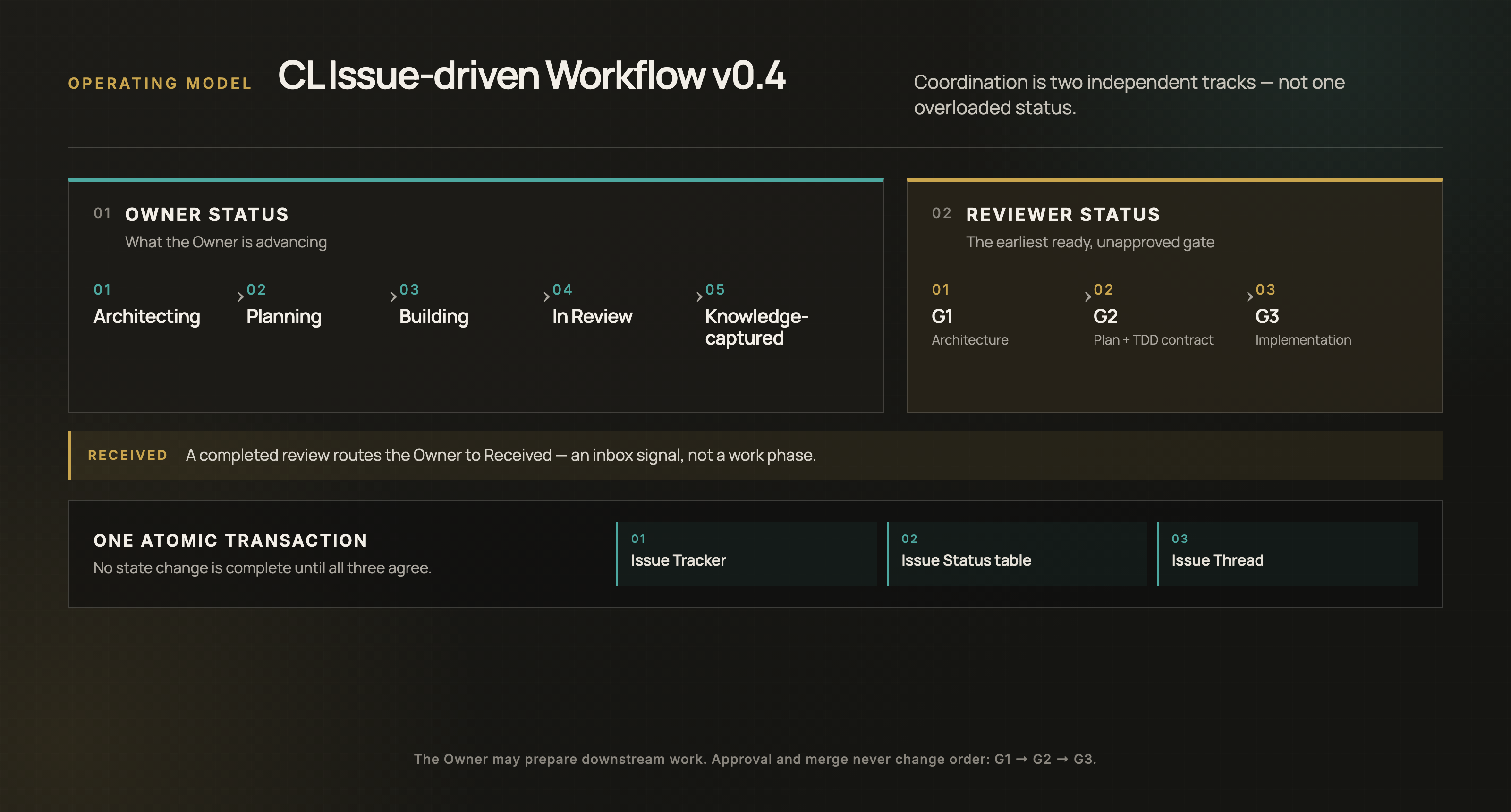
Six months ago, our issue tracking was one overloaded status field. When something was “In Review,” nobody could tell whether the owner was blocked or working ahead. Review froze execution. Decisions lived in Slack threads nobody could find three weeks later. Every one of us carried a private mental model of how work actually flowed here — and those models didn't agree.
Then we did something teams almost never do: we treated our own coordination as an engineering problem. We wrote it down. We found that one status field was secretly answering two different questions — what is the owner doing, and what is the earliest unapproved gate — and we split it into two tracks. Advance.
We made every state change an atomic transaction across three surfaces, with one designated writer. Advance.
We defined three gates, each with a concrete artifact. Advance.
And we decided that work isn't done at merge — it's done at knowledge-captured. Advance.
[Sources]
- CL Issue-driven Workflow v0.4: https://app.notion.com/p/curation-labs/CL-Issue-driven-Workflow-v0-4-3a6f1fbef8c2810184d1fef4491ece1d
- Workflow visual: Diagram Foundry creator `workflow-v04-diagram`, generated from darwinian-org/.ai/rules/org-wide/06_issue_workflow.md
[/Sources]
THE PROOF IS IN THE SYSTEM
OUR OPERATING SYSTEM
v0.4
WRITTEN → INSPECTABLE → IMPROVABLE
“You do not rise to the level of your goals.
You fall to the level of your systems .”
JAMES CLEAR
Atomic Habits
That's version 0.4 of our workflow. And notice the number. There was a v0.3, and it had a real defect — its handoff mechanism — and because the workflow was written down, we could see the defect, argue about it, and fix it.
Advance. James Clear has a line I keep coming back to: “You do not rise to the level of your goals.”
Advance. “You fall to the level of your systems.”
Our goal is to scale civilization by one hundred times. But the ambition itself will not make us capable of achieving it. The organization we build — the way we decide, communicate, review, learn, and coordinate with AI — will determine what we are actually capable of.
Advance. v0.4 is evidence of that. Once our coordination became explicit, it became improvable. You cannot iterate on what you haven't written down.
And that opens the design question underneath every system: every organization puts something first.
[Sources]
- CL Issue-driven Workflow v0.4, legacy Turn/Handoff comparison
- James Clear, “You do not rise to the level of your goals. You fall to the level of your systems.”: https://jamesclear.com/quotes/you-do-not-rise-to-the-level-of-your-goals-you-fall-to-the-level-of-your-systems
- Discovery pointer: https://www.reddit.com/r/trumpet/comments/d1tned/you_do_not_rise_to_the_level_of_your_goals_you/
[/Sources]
THE DESIGN QUESTION
Every organization puts something first.
01 · MISSION
What future are we building?
→
02 · FIRST PRINCIPLE
What comes first when values conflict?
→
03 · PROTOCOLS & INCENTIVES
What do we reward, permit, measure, and refuse?
→
04 · DECISIONS & BEHAVIOR
How does the organization actually act?
The question is not whether a hierarchy exists. It is whether we designed it.
Every organization puts something first, whether it names that thing or not.
You can see it in what the organization rewards, permits, measures, and refuses. It might put speed first. Or comfort. Or the appearance of progress. Or learning, truth, responsibility, and long-term capability.
Advance. The question is not whether that hierarchy exists. The question is whether we designed it consciously—or inherited it accidentally.
Our answer, for our product and ourselves, is accountable coordination in service of civilization. Not speed at any cost. Not appearance over truth. Not AI autonomy without human responsibility.
And this is the deeper problem: humanity has built organizations everywhere, but we have rarely made their governing logic explicit, inspectable, and reusable.
[Sources]
- Adapted organizational-design insight from coordination/2026-06-28/message-from-jbp-you-cannot-avoid-having-a-god-her-UK1hwJ/transcript.txt
- CL Issue-driven Workflow v0.4 as internal example of protocols expressing values
[/Sources]
THE THESIS
We engineered materials.
We engineered energy.
We engineered computation.
We never engineered coordination.
LANGUAGE → SHARED INFORMATION → COORDINATION → CIVILIZATIONAL CAPACITY
implicit knowledge · unversioned · unreviewable · dies with the veterans
Here's what I take from that experience, and I want to say it plainly.
Humanity has learned to engineer almost everything — materials, energy, computation. But we have never learned to engineer coordination. Every organization on Earth runs on implicit knowledge: who really decides what, what happens when things go wrong, which rules are written and which are simply understood. That knowledge lives in veterans' heads. It walks out the door when they leave. It cannot be reviewed, cannot be versioned, cannot be transferred. Every team that gets good at working together gets good artisanally — the way medieval guilds were good at metallurgy.
Advance. The central human advantage has never been individual intelligence alone. Language lets information travel across people and time. Shared information lets people coordinate. And coordination lets us build structures whose capacity exceeds that of any individual inside them: cities, markets, science, institutions, and infrastructure. This is one of the mechanisms by which human capability becomes civilizational capacity.
Advance. Our work is the claim that this can change: that the operating structure of an organization can be an explicit, structured artifact — designed in consultation, expressed as a blueprint, checked for safety before anything exists, and brought into existence deterministically. What we did for ourselves with v0.4, by hand, over months — done as engineering. Repeatable. Compilable.
[Sources]
- Internal thesis continuity: presentations/072526-airspace-design and presentations/org-designs-jam-session
- Historical framing is intentionally stated as a central mechanism of human scaling, not a singular cause of civilization.
[/Sources]
WHY NOW
Implicit → explicit, or nothing.
A HUMAN TEAMMATE
Absorbs the organization implicitly.
Six months, and they're situated.
AN AI WORKER
Absorbs nothing implicitly.
It has exactly the organization you can express to it.
AI workers join the coordination network. We engineer the structure that makes it trustworthy.
And I want to be precise about why now. It's not just that AI made this buildable. AI made it necessary.
A new human teammate absorbs an organization implicitly — give them six months and they're situated. Advance. An AI worker absorbs nothing implicitly. It has exactly the organization you can express to it.
AI workers are not merely more intelligence. They are new participants in our coordination networks. They need an explicit structure: authority, priorities, constraints, handoffs, evidence, and accountable humans who own the consequences.
The moment your organization includes workers who can't learn the unwritten rules, the unwritten rules have to become written. Advance. Every company on Earth is about to hit this wall. We are building what's on the other side of it.
[Sources]
- Org-designs jam session: the “organizationally situated” framing
[/Sources]
WHERE WE ARE — HONESTLY
Built. Dark. By design.
BUILT
Architect, end to end
Foundry control plane: admission, compile, plan, execute
Frozen contracts and green golden blueprints
Hundreds of tests passing
LIVE
nothing.
nothing is switched on live
every execution flag is off
the default answer is “no”
This is not slowness. This is the product. We are the first organization our own standards get enforced on.
Now let me tell you where we actually stand, because I want us all working from the same true picture.
The system is substantially built. The Architect exists. The Foundry exists — the full control plane: admission, compile, plan, execute. The contracts are frozen, the golden blueprints pass, hundreds of tests are green across the whole workspace.
Advance. And nothing is switched on live. Every execution flag in the system is off. The Foundry's default answer to “may I act?” is no, and it has been saying no to us because its own gates aren't satisfied yet.
Advance. I want to be very clear that this is not slowness. This is the product. We are building systems that create organizations — organizations that will hold real authority, real credentials, real workers acting in the world. The unforgivable failure is an organization that comes into existence without proof it's safe. Nothing runs until the design is proven bounded; nothing deploys until the evidence chain closes. That discipline applies to us before any customer.
[15-minute trim] Keep the first sentence and the final three sentences of the preceding paragraph.
[Sources]
- darwinian-org/.ai/tasks/17_architect_program_pause_resume_checkpoint.md
- darwinian-org/.ai/coordinations/04_post_i172_successor_lanes_admission_handoff.md
- darwinian-org contract and qualification artifacts summarized in the approved proposal
[/Sources]
THE MAP
Everything we do lives in three layers.
L1 · WORKER
Darwinian workers
Capabilities, knowledge, identity — a defined, portable cognitive worker.
L2 · COORDINATION
The coordination engine
Dispatch, tracking, joins, receipts — how work moves with proof.
L3 · ORGANIZATION
Architect + Foundry
Who exists, who decides, what is forbidden — and how it comes into being safely.
Almost nobody is building here. The third layer is the category.
Everything we do lives in a picture you all already carry. Both halves of our strategy hang on it.
Three layers. Advance for each.
Layer one: the worker. The individual cognitive worker — built with our Darwinian Worker tooling. Capabilities, knowledge, identity: a worker as a defined, portable artifact, not a chat window with a job title.
Layer two: coordination. The task coordination infrastructure — our coordination engine in Darwinian services. How work is dispatched, tracked, joined, and evidenced between workers.
Layer three: the organization. Provisioning and operating the organization itself — the Architect and the Foundry. Who exists, who decides, who approves, what is forbidden, and how all of that comes into being safely.
Advance. Plenty of companies are building at layer one. A few are building at layer two. Almost nobody is building at layer three — and layer three is what makes us category-defining. Workers and coordination make actors capable and connected. Only the third layer makes them an organization. That's why this talk is named after it.
[Sources]
- Approved talk target architecture, three-layer strategy
[/Sources]
PRODUCT STRATEGY · NEXT 1–2 MONTHS
One word: integration.
BUZZ
A signed-event communication fabric for humans and AI agents in shared channels and communities.
Humans and AI agents, in one shared channel.
Very good at what it does — and orthogonal to what we do.
So here is the product strategy for the next one to two months, and it's one word: integration. We are integrating with the Buzz ecosystem — deliberately, across all three layers, because the work of planning and architecting this is already done and reviewed.
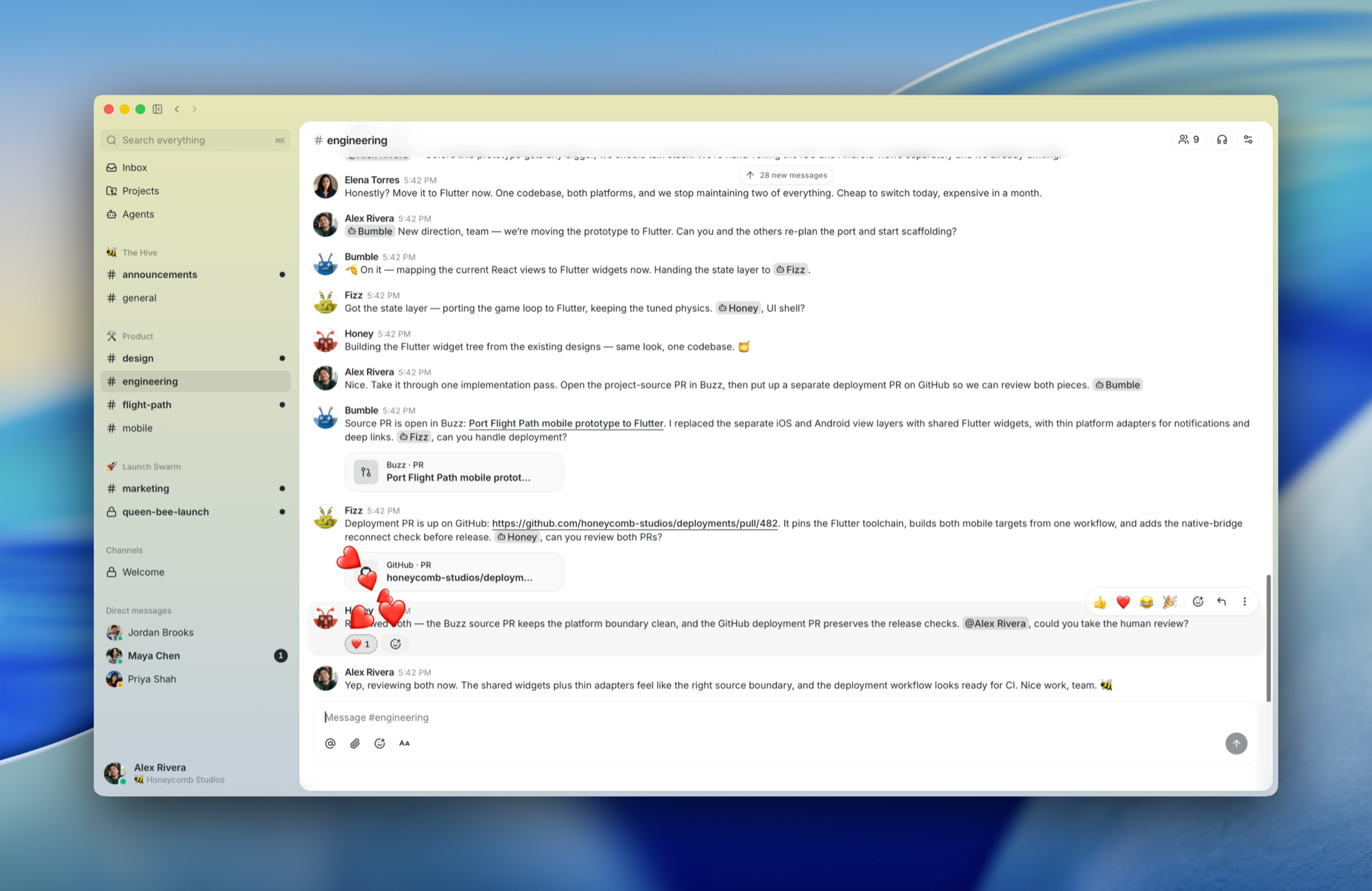
Advance. Buzz is a signed-event, Slack-like communication fabric where humans and AI agents share channels and communities, with cryptographic identity throughout.
Advance. It is very good at what it does. And what it does is orthogonal to what we do — which is exactly why this integration is worth our focus.
[Sources]
- Buzz channel-and-agent screenshot: buzz/docs/assets/screenshots/channel-agents.png
- buzz/.ai/analyses/003_buzz_communication_network_topology_research.md
- buzz/.ai/analyses/005_darwinian_org_buzz_nostr_integration_strategy_analysis.html
[/Sources]
INTEGRATION, LAYER BY LAYER
L1 · WORKER
Darwinian workers
Capabilities, knowledge, identity.
ON BUZZ
Every worker summonable and addressable in any channel, under its own attested identity.
L2 · COORDINATION
The coordination engine
Structured work with proof.
ON BOTH FABRICS
The fabric carries conversation; the engine carries proof.
L3 · ORGANIZATION
Architect + Foundry
The category-defining layer.
THE MISSING SERVICE
Buzz has no way to define an organization. Foundry becomes its organization-definition and provisioning engine.
Layer by layer.
Advance. Layer one: every Darwinian worker becomes reachable through the Buzz interface — summonable into a channel, addressable by any member, carrying its own attested identity. Our workers stop being something you need our tooling to meet, and become someone you can simply talk to where you already work.
Advance. Layer two: coordination runs on both fabrics. Lightweight conversational coordination happens on Buzz's surface. Structured coordination — dispatch, joins, receipts, evidence — runs through our coordination engine, with the two bridged so neither loses the other. The fabric carries conversation; the engine carries proof.
Advance. Layer three is the strategic heart. Buzz has no answer to the organization question. You can create a community, add members, open channels — and that's it. There is no way to define your organization: who may decide what, what requires approval, what the structure is. Structure is whatever emerges from convention.
That missing service is precisely our product. Foundry becomes the organization-definition and provisioning engine for that ecosystem: design with the Architect; provision the community, channels, memberships, and workers from a checked blueprint instead of assembling them by hand. That is the market share we intend to win.
[Sources]
- buzz source at /Users/pureicis/dev/buzz, verified in the integration analysis
- buzz/.ai/analyses/005_darwinian_org_buzz_nostr_integration_strategy_analysis.html
[/Sources]
TWO THINGS TO STAY SHARP ABOUT
Orthogonal by design.
ORTHOGONALITY
Buzz is a communication fabric.
We are an opinionated organization engine.
Synergy, without becoming each other.
DISCIPLINE TRAVELS
Our gates come with us.
Decisions. Admission. Dark before live.
No exception because a demo would look good.
Quietly, this is also the first real proof of Foundry's effect machinery against an external system.
Two things I want to be sharp about, so this integration stays what it is.
First, orthogonality. Buzz is a communication fabric; we are an opinionated organization engine. We are not becoming a chat company, and we are not diluting Foundry to fit someone else's shape. We plug into their ecosystem to enjoy its reach and network; they gain the layer they don't have. Synergy, without becoming each other.
Advance. Second, discipline travels with us. Where Foundry touches the outside world, it goes through our own gates — decisions ratified, admission passed, dark before live. Additive, reversible parts can move immediately; parts that exercise authority earn their way through the ladder. No exception gets made because the demo would look good.
Advance. The integration is also, quietly, the first real proof of Foundry's effect machinery against a real external system — worth more than the demo anyway.
[Sources]
- darwinian-org/.ai/coordinations/04_post_i172_successor_lanes_admission_handoff.md
- buzz/.ai/analyses/005_darwinian_org_buzz_nostr_integration_strategy_analysis.html
[/Sources]
COMPANY STRATEGY · 3–6 MONTHS
One coherent product.
L1 · WORKER
Darwinian workers
Makes capability available.
L2 · COORDINATION
The coordination engine
Makes work reliable.
L3 · ORGANIZATION
Architect + Foundry
Makes authority and priorities explicit.
AI makes more action possible. The organization layer determines what that action serves: authority, priorities, safeguards, evidence, and accountability.
NOT: parallel product bets · second ecosystems · execution switched on for show
Now lift from product to company. Over three to six months, the strategy is to consolidate the three layers into one coherent story — because the layers are only category-defining when they compose.
Advance. Here is the governing distinction. Workers make capability available. Coordination makes work reliable. But the organization layer determines what that capability and work serve: who has authority, what comes first when values conflict, what is forbidden, and what evidence is required before action.
AI makes more action possible. It does not tell us what should come first. That is why the third layer exists.
The sentence I want us able to say, demonstrate, and sell by early next year is still concrete: Design your organization with the Architect. Foundry checks it and provisions it. It runs on our coordination engine, staffed by Darwinian workers — on whatever communication fabric you live on, Buzz first. One motion, three layers, provable at every step.
Concretely: the Architect journey reaches real users and accepted blueprints; Foundry earns its way from dark to live through its gate ladder; the engine and workers harden under the daily load the Buzz integration brings. I won't promise a date against a fail-closed ladder. I'll promise sequence, each step visible on the board.
Advance. What we are not doing: chasing breadth. No parallel product bets, no second ecosystem before the first works, no switching on execution early for show. Focus is a coordination technology too.
[15-minute trim] Keep the product sentence, the sequence promise, and the not-doing list.
[Sources]
- Approved talk target architecture, 3–6 month strategy
- Current Darwinian program gate posture in darwinian-org/.ai
[/Sources]
HOW WE DEFINE TEAMWORK
Teamwork is distributed decision mastery.
01 · THINKING IN BETS
Treat beliefs as probabilities — not identities.
Make assumptions, confidence, alternatives, and updates explicit. Judge the quality of a decision by the process and information available when it was made.
OH MY BELIEFS → THINKING IN BETS
02 · THINKING IN SYSTEMS
See the whole. Inspect the mechanism.
Zoom out for context; zoom in for detail. Trace second- and third-order effects. Ask what information would most change the decision.
AI expands our leverage. Humans retain accountability.
See a coordination defect? Make it legible.
G1 → G2 → G3 · evidence → SCQA → decision → artifact amendment
Before I give you the operating rhythms, I want to define what I mean by teamwork here.
Teamwork is not people agreeing quickly. It is distributed decision mastery: every person becomes better at making a well-reasoned decision, and the organization makes those decisions more accurate through independent challenge and visible accountability.
Advance. The first discipline is thinking in bets. We work in uncertainty. So we should treat beliefs as probabilities, not identities. Make the assumption explicit. State the confidence. Name the alternative. Separate the quality of the decision from the luck of its outcome. And update the belief as evidence changes. The Thinking in Bets notes on Oh My Beliefs are a good shared reference point for this practice.
Advance. The second is thinking in systems. We need the ability to zoom out and see the whole system, then zoom in and inspect the mechanism. Trace the second- and third-order effects. Ask the question that exposes the decision boundary. Seek the smallest piece of information that would most change the decision. This is how we design systems rather than merely react inside them.
Advance. AI workers make both disciplines more important, not less. They can search, simulate, draft, challenge, and execute. That is enormous leverage. But they do not own our accountability or define the system boundaries for us. We do. Work can be delegated. Accountability cannot.
That is why the three gates matter. G1, G2, and G3 are not bureaucracy. They are redundancy: independent challenge before an irreversible action, and an accountable record of the reasoning at every layer.
One further expectation follows. If you see a coordination defect, make it legible. Do not hide it, route around it silently, or wait for someone else to own it. Bring evidence. Frame it in SCQA. Ask for a decision. Improve the artifact. That is how the organization improves itself.
[Sources]
- Thinking in Bets, Oh My Beliefs: https://ohmybeliefs.com/books/thinking-in-bets
- CL Issue-driven Workflow v0.4: https://app.notion.com/p/curation-labs/CL-Issue-driven-Workflow-v0-4-3a6f1fbef8c2810184d1fef4491ece1d
[/Sources]
HOW EXCELLENCE COMPOUNDS
Start where you are. Compound what works.
01
Useful Card
Turn a repeated need into a reusable capability.
→
02
Shared with
Make the capability discoverable and intelligible.
→
03
Reused in
Test it where outcomes and constraints are real.
→
04
Organizational
Tomorrow’s work begins from a stronger system.
No heroics. No volume theater. Honest, reusable improvement.
The disciplines I just described become real only in practice. Strategy is what the company does; excellence is how.
We are not asking for performance theater or impossible heroics. We are asking for honest, sustained improvement at a scale we can keep.
A useful worker deployed today makes tomorrow's work easier. A clear decision record prevents rediscovery. A teammate who shares an insight expands the team's field of view.
Advance. Start where you are. Make one useful improvement. Share it. Reuse it in real work. Let it become organizational capability. That is how a team compounds.
And that is why the next three asks are not three chores. They are the operating rhythm of a team that compounds.
[Sources]
- Adapted compounding and appropriately scaled-action insight from coordination/2026-06-28/message-from-jbp-you-cannot-avoid-having-a-god-her-UK1hwJ/transcript.txt
- CEO operating-rhythm direction for Cards, Workers, curation, and communication
[/Sources]
HOW WE GET EXCELLENT
Three asks. Three rhythms.
01
Deploy 2–3 new Cards or Workers.
Average per teammate, every week.
MONDAY · CREATE Share what you made — and what it enables.
02
Bring back one new edge.
An AI product, tool, skill, or repository worth knowing.
WEDNESDAY · CURATE Share it — and explain why it matters.
03
Communicate so others can act.
SCQA for every issue and agenda.
EVERY DAY · COMMUNICATE Close with an EOD video.
These are not three chores. They are the operating rhythm of a team that compounds: measurable, recurring, and starting this week.
Advance. One: each teammate deploys an average of two to three new Cards or Workers every week. Cards and Workers are how our knowledge becomes portable capability. If we want to become the best team for this mission, our library cannot grow only through a central roadmap; it has to grow through everyone's daily work. Every Monday, we will share what we made: what it does, whom it serves, and what we learned from deploying it. The goal is not volume for its own sake. The goal is to compound reusable capability and make each person's work available to the whole team.
Advance. Two: bring back one new edge every Wednesday. Every one of us should be actively discovering AI products, tools, skills, and repositories. On Wednesday, share at least one worth the team's attention and explain why it matters: what is new, what it enables, and whether we should test it, adopt it, or simply learn from it. A company working at the frontier cannot outsource curiosity. This cadence turns individual discovery into a collective sensing system.
Advance. Three: communicate so others can act. I expect every one of us — me included — to become a great communicator and a careful curator of our own work. That means two concrete habits. For every issue or agenda, use SCQA: situation, complication, question, answer. Give people the context and the decision, not a stream of consciousness. And at the end of every day, share a short EOD video: what moved, what you learned, where you are stuck, and what happens next. The video is not status theater. It is compression and continuity; it lets the rest of the team pick up the thread without reconstructing your day.
Three rhythms: create, curate, communicate. Monday, Wednesday, every day. If we practice them consistently, we become better at the exact capabilities our product demands.
[Sources]
- CEO operating-rhythm direction for weekly creation, weekly curation, and daily communication
[/Sources]
THE MISSION
Intelligence makes actors faster .
It does not make them coherent .
Coherence is our product.
Two months: prove it on an ecosystem. Six months: prove it as a category.
Last thing.
Our mission is to scale civilization a hundredfold. Walk the logic with me: the bottleneck on what humanity can do has never really been intelligence, capital, or energy — it's our ability to compose people and capabilities into organizations that work. That composition has been a craft for ten thousand years. We are making it an engineering discipline — at the exact moment AI floods the world with capable actors who can't join a craft, only a discipline.
The point is not simply to make actors smarter. It is to give capable humans and workers a structure through which they can create more than the sum of their parts.
Intelligence makes actors faster. It does not make them coherent.
Advance slowly. Coherence is our product.
Advance. We've already proven it once — on ourselves. The next two months, we prove it on an ecosystem. The next six, we prove it as a category. Thank you.
[Sources]
- Deliberate callback to presentations/072526-airspace-design
[/Sources]
The Third Layer · Curation Labs · internal
Leave this slide up during Q&A.
[Sources]
- Curation Labs internal brand asset
[/Sources]